Beauty Always Sends Someone the Bill
There is something faintly dishonest about the way we talk about beauty.
We praise it as though it arrives untouched: a perfect phrase, a marble body, a cathedral glowing at dusk. We call such things sublime, transcendent, divine. We rarely ask who carried the stone, who went hungry during the rehearsal, or whose body had to be altered so that the rest of the room might experience three minutes of heaven.
Beauty likes to enter through the front door.
The bill usually comes round the back.
Few chapters in music history make that bargain clearer than the story of the castrati: boys castrated before puberty so that their voices would remain high while the rest of their bodies matured. The operation prevented the ordinary transformation of the male larynx. What emerged after years of ruthless training was a kind of voice Europe had never heard before and has never truly heard since: high but powerful, agile yet sustained by an adult body, capable—at least in the hands of its greatest practitioners—of combining delicacy with almost unnatural force.
Audiences adored it.
Composers reorganised entire operas around it. Courts competed for it. Churches employed it. People crossed borders to hear it and then wrote descriptions so feverish that one begins to suspect eighteenth-century Europe needed either better entertainment or more fresh air.
The successful castrato stood beneath chandeliers while aristocrats wept.
The unsuccessful one generally disappeared.
That contrast is the real story. Not simply that extraordinary voices once existed, but that a civilisation manufactured them deliberately, celebrated the rare triumphs and allowed the ruined majority to dissolve into anonymity.
The music remains magnificent.
The method was monstrous.
Unfortunately, history has never found those two facts difficult to accommodate in the same room.
The Church Wanted Angels, but Apparently Not Women
The castrato did not emerge because a single pope woke one morning and demanded a new species of singer. History is usually less tidy and more embarrassing than that.
For centuries, women were excluded from many church choirs, particularly in papal and Italian ecclesiastical settings. Yet sacred polyphony still required high voices. Boys could sing those parts beautifully, but puberty was an unreliable colleague. Just as a chorister became properly trained, his voice changed, packed its belongings and moved downstairs.
Adult falsettists provided another solution, though their voices were not always considered powerful or stable enough for the increasingly elaborate music being written. Castrati offered continuity: a trained high voice that would not vanish at adolescence.
The Church did not invent every part of the practice, nor was sacred music its only cause. It did, however, help create the demand and became one of the principal institutions in which castrati were employed. When opera appeared in Italy during the early seventeenth century, the same voices moved from chapel lofts into theatres and eventually took possession of the heroic male lead. The singer originally recruited to provide high notes in church became the primo uomo: warrior, emperor, lover, conqueror and, occasionally, a mythological demigod wearing enough brocade to endanger nearby candles.
There is an absurdity here so perfect that satire can hardly improve it.
A culture anxious about the supposed impropriety of women singing in sacred spaces accepted the surgical mutilation of boys as a workable administrative alternative.
Morality, when placed under institutional pressure, can become remarkably inventive.
The operations were often concealed beneath convenient explanations. A boy had suffered an accident. A wild animal had attacked him. He had fallen from a horse. The horse, throughout this period, appears to have been responsible for an astonishing number of highly selective injuries to musically promising Italian children.
Everyone understood what was happening.
Officially, nobody did.
This gave the system its necessary layer of hypocrisy: the practice could remain forbidden, shameful or unspoken while the institutions benefiting from it continued to employ the resulting singers.
One must admire the efficiency, if nothing else. Europe had managed to combine bodily violence, religious anxiety, class exploitation and superb counterpoint without allowing any one of them to interfere with ticket sales.
How to Build an Impossible Voice
The word castrato can sound almost like the name of a vocal category, something to be placed neatly beside tenor, baritone and bass.
It was not a voice type in the ordinary sense.
It was the consequence of an irreversible act performed on a child.
Castration before puberty prevented the normal rise in testosterone that would otherwise enlarge the larynx and lengthen and thicken the vocal folds. The voice therefore retained much of its prepubescent height. The rest of the body, however, continued developing under altered hormonal conditions. Historical and medical accounts describe many castrati as unusually tall, with long limbs and large thoracic structures. Combined with intensive training, this could produce enormous breath control and a high voice driven by a body far larger than that of a boy soprano.
The resulting sound was neither simply male nor female, neither child nor ordinary adult.
It occupied an acoustic category of its own.
Descriptions from the period speak of brilliance, volume, range, flexibility and astonishing endurance. A great castrato could sustain long melodic lines, dispatch rapid coloratura and project over an orchestra without surrendering the lightness expected of a high voice. The finest singers developed extraordinary control over dynamics, ornamentation and breath. They could swell a single note from near-whisper to full force and back again, apparently without needing to perform the vulgar human activity known as breathing.
Naturally, legends accumulated.
Farinelli could hold a note for longer than anyone thought physiologically polite. He could defeat trumpeters in contests of breath and ornamentation. His voice cured royal melancholy, silenced rival singers and presumably caused fruit to ripen several weeks early.
Some stories are credible. Others have been polished by several centuries of admiration. This scarcely matters. Virtuosity at that level inevitably produces mythology. Paganini had his pact with the devil; Liszt had women fainting into upholstery; Farinelli had lungs that appeared to operate under a separate treaty with nature.
Still, it would be a mistake to imagine that castration alone produced the voice.
The operation created a physiological possibility. Training created the singer.
The most promising boys entered conservatories or studied under demanding masters for years. Their daily schedules could include vocal exercises, solfège, keyboard study, counterpoint, improvisation, composition, diction and sustained physical work on breath. The instruction was severe because the profession demanded far more than unusual anatomy. A castrato who could merely sing high was of limited use. He had to ornament, improvise, act, project, phrase and survive music written by composers who regarded mercy as a threat to artistic standards.
The operation was the beginning of the ordeal, not the end.
When Europe Lost Its Mind
They performed for kings, popes and packed opera houses. They commanded exceptional fees, attracted obsessive admirers and exerted enough influence to make composers, impresarios and fellow singers deeply irritated. Their costumes were extravagant, their entrances calculated, their rivalries public. Audiences shouted, gossiped, chose sides and occasionally behaved in ways that would make a modern fan community look restrained.
The operatic hero of the period was not necessarily a dark-voiced, broad-chested tenor of the later Romantic kind. He might be a soprano or alto castrato singing military courage, erotic desire and royal authority through a voice suspended above ordinary sexual categories.
There was no contradiction in this for the audience.
Or rather, there were several contradictions, and the audience enjoyed all of them.
The castrato could embody martial masculinity onstage while possessing a body viewed by society as altered, incomplete or mysterious. He could be worshipped publicly and mocked privately. He could enjoy immense fame yet remain vulnerable to gossip about sexuality, identity and physical difference. His very ambiguity increased the fascination.
Then there was Farinelli.
Born Carlo Broschi in 1705, he became the most famous castrato of his age and perhaps the most famous singer in eighteenth-century Europe. His career carried him through Italy, Vienna, London, Paris and eventually Madrid, where he sang for King Philip V of Spain. Contemporary reports praised his range, breath, precision and expressive power. He did not merely sing difficult music; he made difficulty seem like a rumour circulated by less talented people.
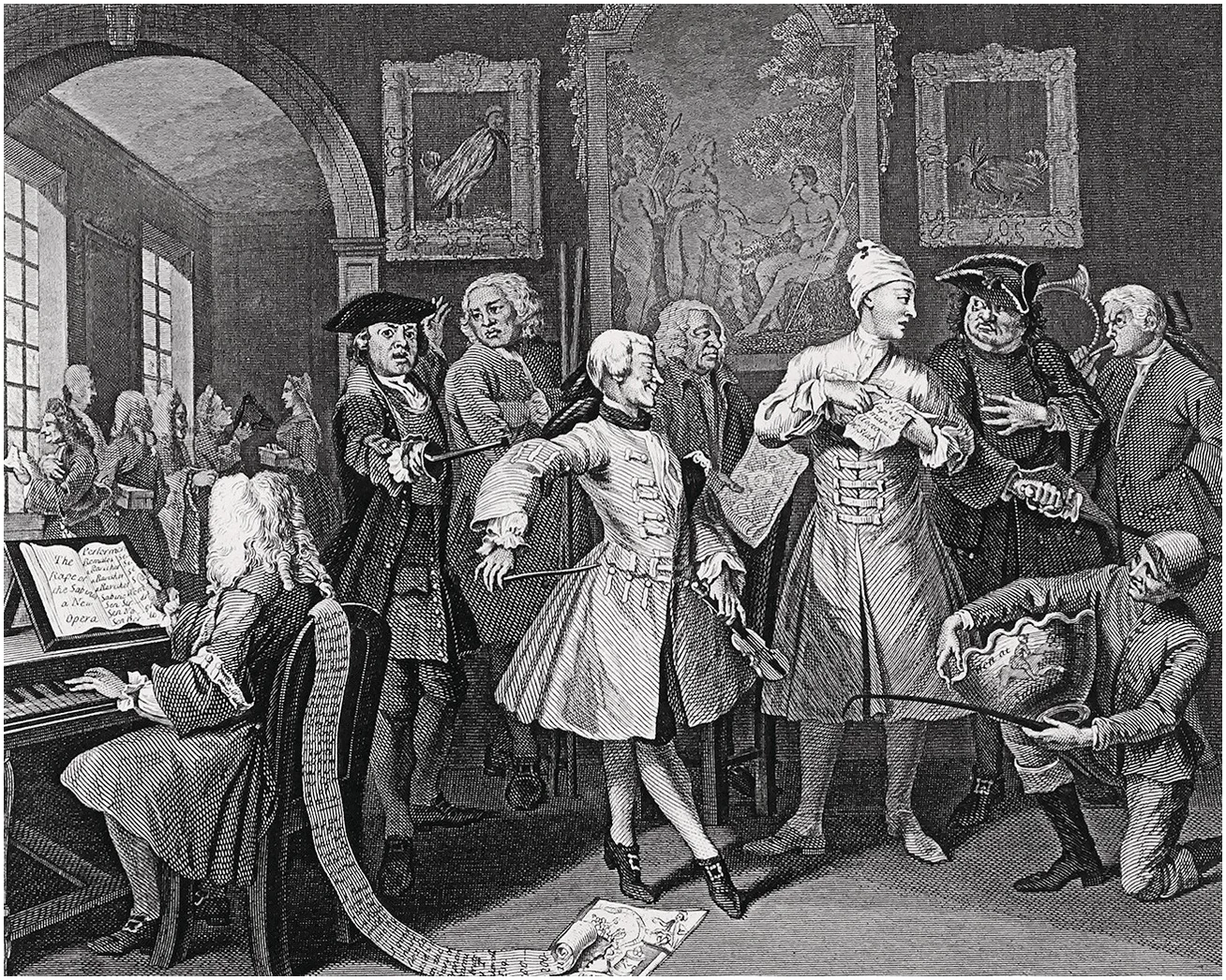
A famous caricature of the virtuoso singer imagines the audience screaming approval of the very knife that had made him possible.
There, compressed into one grotesque cheer, is the entire moral problem.
The public loved the result enough to applaud the instrument of its creation.
And yet Farinelli’s life cannot stand in for all castrati. He was the dazzling exception around which the industry built its promises. His fame made the procedure appear to poor families as a possible route out of poverty. A gifted son might become wealthy. He might support his parents. He might enter a world otherwise closed to them.
Perhaps.
That word has ruined many children.
For Every Farinelli, a Corridor Full of Unnamed Boys
The history of the castrati is distorted by survival.
We remember the stars because stars leave documents: contracts, portraits, letters, hostile reviews, extravagant anecdotes, jewellery, salaries and admirers who feel obliged to write everything down. Failure rarely produces an archive.
One often-cited historical estimate suggests that, at the height of the practice, thousands of Italian boys may have been castrated each year. The exact number remains uncertain, and such figures should be treated cautiously. The broad reality is not in doubt: only a small fraction achieved elite careers. Many ended up in modest church choirs. Others possessed voices too ordinary, too weak or too poorly trained to justify what had been done to them. Some suffered medical complications. Some died. Most disappeared so thoroughly that even their names have not survived.
This is the arithmetic beneath the miracle.
One Farinelli required a culture willing to risk countless boys who would never become Farinelli.
Their families were frequently poor. The promise of musical education and social ascent must have appeared extraordinary in societies where birth usually dictated the limits of a life. It would be easy to dismiss the parents as greedy or barbaric, and some undoubtedly behaved brutally. Poverty, however, makes consent a slippery word. A family choosing between hunger and an improbable chance at wealth is not making a decision under conditions that deserve to be called free.
The boy himself was scarcely in a position to understand what was being taken from him.
Perhaps he was told that he had a beautiful voice. Perhaps a teacher praised him. Perhaps adults began speaking of courts, theatres and money. Perhaps he imagined applause without possessing any conception of what the applause would cost.
Children are very good at believing the future when adults describe it confidently.
Then came the operation.
After that, training.
After that, judgment.
If the voice proved exceptional, the world might call him divine.
If it did not, the world had other boys.
This is where the romantic portrait must stop. The history cannot be redeemed by beautiful arias. Art does not travel backwards through time and obtain the consent of its victims.
The music may be glorious.
Glory is not an acquittal.
Music Written for a Body That No Longer Exists
The repertoire left behind by the castrati is astonishing.
Composers such as Handel, Porpora, Hasse and others wrote arias designed for singers with exceptional range, agility and breath. Long phrases unfold over restless orchestral textures. Coloratura passages run at speeds suggesting that the composer had recently been insulted by the performer and intended revenge. Wide leaps, sustained notes and elaborate ornamentation require athletic control even from today’s finest singers.
The roles have not vanished. They are now sung by countertenors, mezzo-sopranos and sopranos, depending on the range, dramatic context and production.
Modern countertenors have achieved remarkable technical and expressive sophistication. Their sound is no longer a specialist curiosity kept behind glass in the early-music department. Singers such as Alfred Deller, James Bowman, Andreas Scholl, Philippe Jaroussky, Jakub Józef Orliński and others have helped turn the countertenor into a major modern operatic voice.
Yet a countertenor is not a castrato.
Most countertenors produce their upper register primarily through a developed falsetto or related mechanism. The castrato’s voice emerged from a different anatomy: a larynx that had not undergone ordinary male puberty, combined with an adult respiratory system and intensive lifelong training. The overlap in repertoire does not erase the physiological difference.
Nor should we say that the old arias are simply “unsingable” today. Many are sung brilliantly. Some sit more comfortably in modern female voices; others suit countertenors; a few remain brutally difficult for almost everybody, which may have been the composer’s method of maintaining discipline backstage.
What cannot be recreated exactly is the original instrument.
We have the scores. We have descriptions. We have treatises on ornamentation and technique. We can reconstruct theatres, orchestras, bows, tunings and performance conventions with impressive care.
The body itself is gone.
There is something strangely moving about that. Music is often praised for outliving its makers, but vocal music never entirely escapes the body for which it was imagined. A violin made in 1720 may still be played. A human anatomy engineered in 1720 should not be reproduced.
For once, the loss is a sign of moral progress.
Alessandro Moreschi and the Gramophone at the End of the World
There is, however, one narrow crack through which the lost voice reaches us.
Alessandro Moreschi, a singer in the Sistine Chapel Choir, was the only known traditional castrato to make commercial gramophone records. He recorded at the Vatican in 1902 and again in 1904, leaving a small group of surviving performances. He was no Farinelli. He belonged to a later musical culture, sang mainly sacred repertoire and was recorded when he was already in middle age. The recording technology was primitive, the accompaniment uneven and the performance style far removed from modern taste.
Listening to him is therefore a complicated experience.
The sound emerges through hiss, distortion and the narrow acoustic tunnel of early recording. His phrasing can seem extravagant. The portamento is pronounced. The intonation and ensemble do not always conform to contemporary expectations. Listeners approaching the records in search of a perfectly preserved eighteenth-century operatic supervoice will be disappointed.
That is not what the recordings contain.
They contain a man born in 1858, singing into machinery barely capable of holding him.
Even so, there are moments when the historical distance collapses. The tone appears high, penetrating and curiously weighty. It does not sound like a boy soprano, a woman or a modern countertenor. There is an unfamiliar density inside the upper register, something simultaneously delicate and forceful.
Then the gramophone swallows it again.
Is the voice beautiful?
Sometimes.
Is it eerie?
Undeniably.
But “eerie” can be a lazy response to any sound whose conventions we no longer understand. Moreschi was trained within a nineteenth-century ecclesiastical style that used expressive devices now considered excessive. Early recording further distorts his tone. We are hearing his body, his school of singing, the acoustics of the Vatican, the limitations of the horn and more than a century of changing taste all at once.
It would be unfair to ask one aging chapel singer to resurrect the whole age of Farinelli.
He cannot tell us exactly what the greatest castrati sounded like.
He can only prove that the voice was real.
The records do not open the past. They let a little air escape from it.
To me, Moreschi sounds less like a ghost than a person trapped inside the idea of a ghost. The hiss begins. The piano finds its footing. Then a voice enters from a category history has abolished.
For a few minutes, the dead technology and the vanished anatomy keep each other company.
How Cinema Manufactured a Voice It Refused to Reproduce
The best-known dramatic film about this world is Gérard Corbiau’s Farinelli, released in 1994.
It is visually extravagant, historically liberal and committed to the ancient cinematic principle that every famous artist’s life can be improved by adding more sex, jealousy and candlelight. It should not be mistaken for a documentary. The film rearranges relationships and events freely, particularly in its treatment of Farinelli and his brother Riccardo.
Yet its central technical problem was fascinating: what voice should come out of the actor’s mouth?
No living singer possessed Farinelli’s anatomy, and hiring an authentic castrato was, mercifully, not an available production option. The filmmakers therefore created a synthetic voice by digitally combining the timbres of countertenor Derek Lee Ragin and soprano Ewa Małas-Godlewska.
The result is deliberately uncanny. It has the brightness and upper extension associated with a soprano, blended with qualities from a male high voice. It is not an archaeological reconstruction. No computer can verify how Farinelli sounded in an opera house three centuries ago. It is an artistic hypothesis—a beautifully engineered answer to an unanswerable question.
That may be the most honest way cinema could have handled the subject.
The historical castrato voice was itself the product of a culture forcing incompatible qualities into one body: childhood register, adult power, masculine stage identity, sexual ambiguity, sacred function and theatrical glamour.
The film builds another impossible voice, this time without a knife.
One hopes civilisation has learned something from the change in method.
Can We Admire the Sound Without Forgiving the System?
The uncomfortable temptation in this story is to allow beauty to explain the violence.
Listen to an aria written for Farinelli or Senesino. Hear the phrase rise, turn, gather breath and remain suspended over the orchestra with an ease that seems to disobey the body. It becomes possible, for a dangerous instant, to feel the logic of the people who wanted such voices.
That does not mean we understand why “they” did it in any morally generous sense.
It means we understand why the sound created demand.
Demand is not innocence.
The audience did not hold the knife, perhaps. The composer did not perform the operation. The noble patron may never have met the boy before he became a famous singer. Responsibility was distributed across enough people that each could admire the final product without feeling personally stained by its creation.
This is how cultured societies often manage cruelty. They divide the process.
One person chooses the child. Another performs the procedure. Another provides the training. Another writes the aria. Another purchases the ticket. By the time the note reaches the opera house, it appears to have no connection to the room in which the body was altered.
The violence has been edited out of the performance.
Only the beauty remains visible.
That pattern is not confined to Baroque opera. We still admire products while avoiding questions about labour, celebrate performers while ignoring what institutions do to them, and praise discipline without asking when discipline became exploitation. The castrati disturb us because the wound is literal and impossible to disguise. Their story makes the hidden cost of excellence horribly anatomical.
Still, refusing to hear the music would not restore what was taken.
The better response is more difficult: to listen without allowing admiration to become absolution.
We can acknowledge the genius of the repertoire, the discipline of the singers and the extraordinary power of the voices. We can also name the system for what it was: an industry built on mutilating children, sustained by poverty, institutional hypocrisy and public appetite.
Both truths must remain audible.
A clean moral ending would be comforting.
The music does not offer one.
Coda: The Note and the Silence Beneath It
The age of the castrati is over.
Its scores remain open on music stands. Its roles return to the stage in new bodies and new voices. Countertenors shape the phrases differently. Mezzo-sopranos bring their own colour and strength. Conductors adjust tempos. Scholars debate ornaments. Audiences applaud.
The notes survive, but their original instrument has vanished.
That absence should not be treated merely as a loss to music. It is also evidence that there are sounds we have decided we are no longer entitled to manufacture.
Perhaps this is the proper way to remember the castrati: neither as grotesque curiosities nor as ethereal creatures hovering outside ordinary humanity. They were people. Some were brilliant, vain, difficult, funny, wealthy, frightened, ambitious or exhausted. Some found genuine power within lives shaped by an act they had not chosen. Others received neither fame nor consolation.
Their voices were not supernatural.
They were made to sound that way at a human cost.
So when an aria written for a castrato rises today—through a countertenor, a soprano or a mezzo—listen to the virtuosity. Enjoy the improbable leaps. Let the ornamentation glitter. There is no virtue in pretending the music is less beautiful than it is.
But hear the silence underneath it too.
Hear the thousands whose names never reached a playbill. The boys whose promised futures ended in provincial choirs, illness or obscurity. The families who believed they were purchasing an escape from poverty. The institutions that condemned the act in theory and profited from its results in practice.
A perfect note does not erase the body that paid for it.
Perhaps the highest form of listening is to let the beauty remain beautiful without permitting it to become innocent.