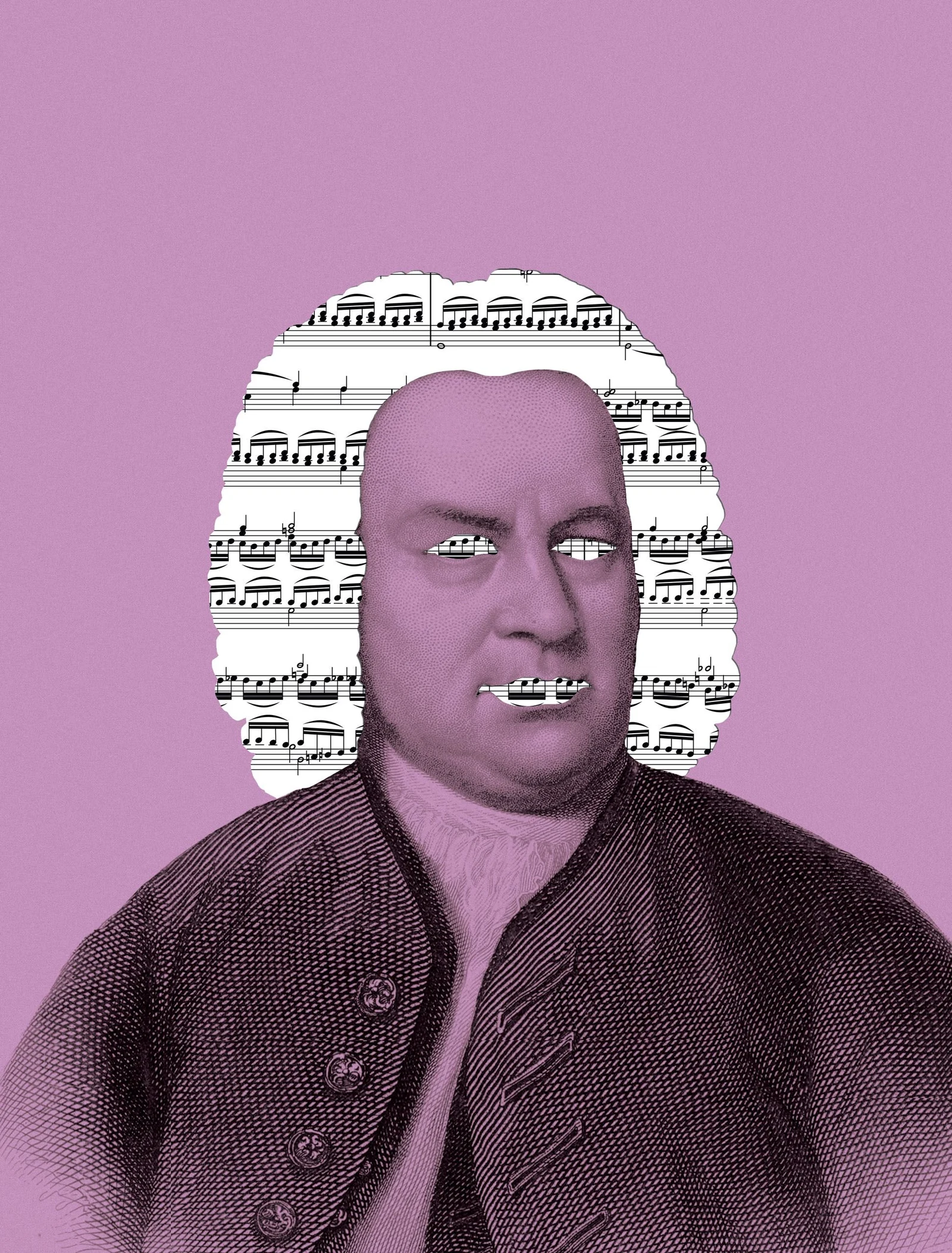
«“Preludes and fugues through all the tones and semitones, both as regards the major third or Ut Re Mi and as concerns the minor third or Re Mi Fa, for the use and profit of musical youth desirous of learning, as well as for the pastime of those already skilled in this study, composed and prepared by Johann Sebastian Bach, presently Capellmeister to His Serene Highness the Prince of Anhalt-Cöthen and director of his chamber music.”»
From Bach’s title page to Book I of The Well-Tempered Clavier, 1722
Why Does E Major Make Me Want to Dance, While F Minor Appears to Know My Childhood?
Every musician eventually develops an unreasonable opinion about keys.
E major is radiant. C minor has grievances. B-flat major wears a well-cut coat and knows how to enter a room. F-sharp major looks magnificent but expects you to make an effort. E-flat minor has read your diary and is waiting for you to bring up the subject first.
None of this is scientifically respectable in quite the way musicians would like it to be, but that has never prevented us from believing it with tremendous conviction.
Sit at a piano long enough and the keys begin to acquire personalities. One feels open, another enclosed; one seems to rise naturally from the instrument, while another appears to have been discovered beneath the floorboards of an abandoned church. Even on a modern piano, where the intervals have been engineered into near-perfect regularity, musicians still speak of the brightness of sharps, the warmth of flats, the severity of D minor, the ceremonial brilliance of D major. We inherit these associations from instruments, repertoire, notation, physical gesture, acoustics, history and, quite possibly, several generations of composers making dramatic faces while discussing C minor.
But before the modern keyboard became the polite, standardised citizen we know today, the differences between keys were not merely poetic. They were built into the tuning itself.
A key could genuinely sound smoother, harsher, purer or more unstable than its neighbour. Modulating from one tonal region to another was not simply a change of harmonic address. It could feel like crossing a border. The thirds altered. The fifths tightened or widened. A previously agreeable instrument might suddenly reveal that it had been tolerating you rather than supporting you.
This is the world behind Johann Sebastian Bach’s Well-Tempered Clavier: a world in which tuning was not an invisible technical prerequisite but part of the expressive landscape. Bach did not merely write in all twenty-four major and minor keys because he enjoyed administrative completeness. He was exploring what had become possible when a keyboard could move through the entire tonal universe without some remote key collapsing into the musical equivalent of farm machinery.
The result was neither a dry tuning demonstration nor a monumental exercise book, though it has served as both. It was a map of a newly navigable world.
And naturally, Bach filled that world with fugues, because apparently discovering an expanded harmonic universe was not enough. He also had to populate it with several independent melodies arguing flawlessly at the same time.
The Octave Has a Mathematical Problem
The difficulty begins with an unpleasant fact: nature does not arrange itself for the convenience of keyboard players.
Certain intervals sound especially stable because their frequencies relate through simple numerical ratios. An octave corresponds to 2:1. A pure fifth corresponds to 3:2. A pure major third corresponds to 5:4. These relationships are acoustically elegant, physically intelligible and deeply satisfying to the ear.
Unfortunately, they do not all fit neatly into a twelve-note cycle.
Stack twelve mathematically pure fifths and you do not arrive exactly at the same pitch as seven octaves. The two routes come close, but not close enough. The discrepancy is known as the Pythagorean comma, which sounds like an obscure punctuation mark but has caused far more trouble than most commas ever manage.
Major thirds introduce further complications. Tune them according to the pure 5:4 ratio and they can sound wonderfully calm—almost unnervingly smooth compared with the major thirds of a modern piano. Yet preserving those pure thirds across a complete keyboard requires compromises elsewhere. Somewhere in the system, one interval must pay the bill.
That is the central problem of temperament. You cannot preserve every interval in perfect purity while maintaining a closed, usable system of twelve notes. Something has to be adjusted. A fifth must be narrowed. A third must be widened. The tuning has to distribute its inaccuracies according to some principle, aesthetic or practical.
Temperament is therefore less the science of making an instrument perfectly in tune than the art of deciding how it will be imperfect.
This is a remarkably human discipline.
It also explains why arguments about tuning can become unexpectedly emotional. To choose a temperament is to decide which relationships deserve purity, which may tolerate distortion, and where the ugliest compromise should be hidden. This is already dangerously close to politics, marriage and university administration.
Mean-Tone: Beautiful Thirds and One Very Bad Neighbourhood
For much of the Renaissance and early Baroque period, varieties of mean-tone temperament offered an attractive bargain. The tuning favoured major thirds, making them far sweeter and purer than those on a modern equal-tempered piano. In the keys closest to the instrument’s centre, chords could glow with an almost vocal consonance. Polyphonic music rested gracefully. Cadences arrived with the satisfaction of a door fitting perfectly into its frame.
The trouble began when one wandered too far.
Because the tuning concentrated its compromises in particular places, remote keys could contain intervals so distorted that they earned the name “wolf.” The wolf interval did not merely sound colourful or piquant. It howled. A fifth that ought to support the harmony might instead sound as though two instruments had entered into a legal dispute.
Mean-tone tuning was therefore magnificent within its preferred territory and increasingly hazardous outside it. It gave composers a beautifully cultivated garden but warned them not to climb over the wall.
For much early music, this was not a serious limitation. Composers did not necessarily need to travel through every key. Instruments, genres and local conventions each had their accustomed tonal regions. A keyboard could be tuned to make the most frequently used harmonies exceptionally beautiful, and the distant keys could remain theoretical provinces inhabited by mathematicians and reckless organists.
Then musical language became more adventurous. Chromaticism expanded. Modulation grew more ambitious. Composers wanted access to keys that earlier systems treated like unlicensed premises.
The old garden was no longer large enough.
Well Temperament: Every Door Opens, but the Rooms Are Not Identical
The phrase “well-tempered” does not refer to one universally agreed tuning system. It describes a family of approaches designed to make all keys usable while preserving meaningful differences among them.
Systems associated with theorists and musicians such as Andreas Werckmeister, Johann Philipp Kirnberger, Francesco Antonio Vallotti and others distributed tuning discrepancies more widely than mean-tone systems did. Instead of allowing several keys to sound exquisite and condemning others to acoustic exile, well temperaments made the entire keyboard available.
Available, however, did not mean uniform.
Some fifths were purer than others. Some thirds were calmer; others were more tense. The keys retained individual acoustic profiles. A piece in C major and a piece in F-sharp major did not merely begin on different notes. They inhabited differently proportioned harmonic spaces.
This is where the old idea of “key colour” becomes more than romantic vocabulary. Under an unequal temperament, the intervallic structure of each key genuinely changes. A major third in one tonal region may be relatively smooth, while the corresponding third elsewhere may possess a sharper, more agitated beat. A modulation can therefore alter not just pitch level but texture, tension and emotional atmosphere.
You may leave home in C major, travel through several increasingly remote regions and return with the distinct impression that the furniture has remained in place but your relatives have changed.
That expressive inequality was not a defect. It was one of the system’s attractions. Well temperament allowed freedom without erasing geography. A composer could move through all twenty-four keys, yet every destination retained an accent.
The exact temperament Bach used—or had in mind for The Well-Tempered Clavier—remains disputed. Scholars have proposed various solutions, some based on surviving theoretical systems and others on the decorative loops Bach drew at the top of the title page, which have been interpreted as possible tuning instructions. The debate is intricate, fascinating and capable of consuming an otherwise healthy adult’s entire weekend.
What matters for the music is that Bach’s “well-tempered” world should not be confused automatically with modern equal temperament. He was celebrating a keyboard on which all keys could function, not necessarily one in which all keys had been rendered acoustically interchangeable.
That difference is small on paper and enormous in the ear.
Equal Temperament: Democracy, Air Travel and Slightly Disappointing Thirds
Modern equal temperament solves the tuning problem with admirable efficiency. The octave is divided into twelve precisely equal logarithmic steps. Every semitone has the same size. Every key contains the same pattern of intervallic relationships. A piece can be transposed from C major to D-flat major without the tuning system developing a personality crisis.
This arrangement is extraordinarily practical. It supports modulation into any key, enables standardisation across instruments and allows ensembles to meet without first negotiating a separate acoustic constitution. Modern pianos, electronic keyboards, fretted instruments and much of contemporary music-making depend upon its consistency.
The price is that almost every interval except the octave is slightly impure.
The fifths are close enough to purity that few listeners object. The major thirds are more conspicuously wide compared with their pure counterparts, though generations of exposure have taught modern ears to accept them as normal. Equal temperament spreads the error evenly, ensuring that no key is uniquely blessed and none uniquely cursed.
It is a splendid public transport system. Every district is connected. The trains run on time. The signs are legible. Nobody has a particularly interesting journey.
That is unfair, of course. Equal temperament does not make music emotionally bland. Beethoven does not cease to be Beethoven because the piano has evenly spaced semitones, and no sensible person hears the Goldberg Variations on a modern instrument and complains that the absence of Werckmeister III has ruined breakfast.
Key character also survives through register, instrumental resonance, fingering, notation, learned associations and compositional history. D major still lies brilliantly on the violin. E-flat major still carries the weight of centuries of ceremonial and heroic writing. B major still places a pianist’s hand differently from C major. Equal temperament neutralises one source of key distinction; it does not erase every other one.
Still, something is lost when harmonic geography is flattened. In an unequal temperament, modulation can change the internal flavour of the intervals themselves. In equal temperament, the same intervallic recipe follows you everywhere.
It is the difference between travelling through places with local cuisines and visiting the same international hotel buffet in twelve cities.
The buffet may be excellent. One occasionally wants a dish that could not have been served anywhere else.
Bach Opens Every Door
In 1722, Bach assembled the first book of The Well-Tempered Clavier: twenty-four preludes and fugues, one pair in each major and minor key, arranged chromatically from C major through B minor. Roughly two decades later, he produced a second collection following the same plan. Together, the two books contain forty-eight paired works.
People sometimes describe the collection as though Bach had set himself a technical challenge and completed it with intimidating efficiency: one prelude and one fugue per key, all boxes ticked, thank you very much.
This misses what is extraordinary about the project.
The pieces are not interchangeable demonstrations poured into different tonal containers. Each prelude establishes its own world of motion, touch and rhetoric. Some unfold like improvisations. Some resemble dances, inventions, ariosos, toccatas or études. One may be built from rippling figuration; another may proceed with the gravity of a procession. Some appear almost transparent on the page and become treacherous the moment the fingers attempt diplomacy.
The fugues are even more various. They differ in tempo, character, number of voices, density, subject design and contrapuntal strategy. Some are playful; some severe. Some move with bureaucratic precision, others with theatrical brilliance. A few seem to smile. Several appear to know the date of your death but have decided not to mention it.
The title page presents the collection as material “for the use and profit of musical youth desirous of learning” and for the enjoyment of those already skilled. Bach was not being falsely modest. The pedagogical purpose is real. The collection teaches touch, fingering, articulation, harmony, voice-leading, imitation, rhythmic control, tonal planning and contrapuntal thought.
Yet it teaches none of these things abstractly.
Bach’s pedagogy is inseparable from invention. He does not hand the student a rule and then provide a lifeless specimen. He creates a complete musical organism in which the rule becomes audible, necessary and expressive. One learns because the music demands a particular kind of attention.
This may be the most intimidating thing about Bach: even his exercises have souls.
Twenty-Four Keys, Twenty-Four Climates
Under a genuinely unequal well temperament, moving through the cycle of keys would have meant passing through changing intervallic colours. Some tonalities would feel open and resonant; others tense, polished, shadowed or brilliant.
It is tempting, therefore, to assign each key a poetic identity.
C major becomes white light. E-flat minor becomes velvet dusk. B major is champagne in a room where everyone speaks slightly too elegantly. F minor is black coffee after midnight, consumed beside a decision you already know is unwise.
These descriptions are not analytical facts, and they should not be mistaken for a secret dictionary Bach left behind. A key does not possess one fixed emotion. C minor can be tragic, militant, comic or tender depending on what a composer does with it. F major is not legally required to contain shepherds.
Still, the progression through all twenty-four tonalities creates the sensation of walking through a large house in which every room has been built according to a related but distinct proportion. The underlying architecture remains Bach’s, but the light changes. So does the air.
This is why The Well-Tempered Clavier feels larger than a survey. Bach did not simply prove that every key could be used. He showed that each one could sustain an individual musical argument.
A lesser composer might have produced twenty-four demonstrations of access.
Bach produced twenty-four reasons to enter.
The Fugue: A Conversation in Which Everyone Has Prepared
The word “fugue” comes from the Latin fuga, associated with flight and pursuit. This is apt, because a fugue often feels like an idea chasing itself through several minds.
A voice introduces the subject: a compact musical statement with enough rhythmic and melodic identity to survive repeated transformation. A second voice enters with an answer, typically at the dominant or another related level. A third may follow, then a fourth. Around these entries, the remaining voices continue with countersubjects or freer material.
The subject passes from one line to another until the listener begins to hear it less as an isolated melody than as a governing presence. It appears in different registers, tonal regions and contrapuntal circumstances. Sometimes it enters plainly. Sometimes it arrives disguised. Occasionally it appears at precisely the moment one had stopped expecting it, which is one of Bach’s preferred methods of making the listener feel both delighted and mildly incompetent.
A fugue is often described as an intellectual form, and it is certainly capable of intellectual rigour. But “intellectual” can be a dangerous word in music. It suggests that the listener is expected to admire the machinery from a safe distance, possibly while wearing spectacles.
A good fugue is not a diagram. It is drama generated through musical identity.
The voices possess independence, yet they belong to the same argument. One may rise while another falls. One sustains a note while another moves rapidly beneath it. Their rhythms overlap without collapsing into a single texture. The listener experiences unity and multiplicity at once.
This is counterpoint: not several melodies occurring simultaneously by accident, but several purposeful lines sharing harmonic space without surrendering their individuality.
One might compare it to a sophisticated group conversation, though most group conversations contain less inversion and considerably more interruption.
Counterpoint Is Not the Opposite of Feeling
Bach’s contrapuntal mastery is so celebrated that it sometimes obscures his emotional intelligence. We marvel at the construction and forget that construction is how the emotion is delivered.
Consider stretto, in which entries of the subject overlap before the previous statement has finished. The technique demonstrates contrapuntal skill, certainly, but it can also create urgency, compression, excitement or inevitability. The subject begins to crowd itself. Time seems to narrow. The music acquires the pressure of an argument in which everyone has reached the decisive sentence simultaneously.
Augmentation lengthens the note values of a subject, making it move more slowly. Diminution compresses them. Inversion turns its intervals upside down: a rising gesture becomes a falling one, and vice versa. Retrograde reverses the order of notes, though Bach uses literal retrograde less obsessively than later textbook mythology sometimes implies.
These procedures sound academic when listed. In music, they can be theatrical.
A subject heard slowly beneath faster voices may feel monumental, as though the original idea has grown beyond the scale of the people discussing it. A diminished version can become nervous, witty or feverish. An inversion may sound like a reflection in dark water—recognisable, but altered in moral character.
Bach’s genius lies not in using such devices for their own sake but in making them seem inevitable. The technique does not arrive carrying a sign that says ADVANCED COUNTERPOINT NOW IN PROGRESS. It is absorbed into the rhetoric of the piece.
He does not solve puzzles in public.
He makes the solution sing.
Harmony, Quietly Misbehaving in the Background
The contrapuntal surface of a fugue can make us forget how adventurous Bach’s harmony is.
His music moves with a tonal intelligence so assured that even striking chromatic events often feel natural. Secondary dominants intensify temporary harmonies. Diminished chords open hidden doors between tonal regions. Suspensions delay consonance until the delay becomes more expressive than the resolution. Chromatic lines pass through the inner voices, sometimes unnoticed by the casual listener but responsible for much of the emotional temperature.
Bach modulates with the confidence of someone who has already inspected every possible route and chosen the one that allows the bass line to make a private joke.
In a fugue, the harmony cannot simply be imposed from above. It grows from the interaction of the voices. Each line must remain melodically convincing while contributing to a coherent harmonic progression. The vertical chords are produced by horizontal lives.
That is one of counterpoint’s deepest lessons. Harmony is not merely a sequence of blocks. It is what happens when independent motions agree, collide, suspend, yield and continue.
A chord in Bach is often less an object than an event.
It comes into existence because one voice has arrived, another has not yet left, and a third is passing through with suspiciously elegant timing.
The Prelude and the Fugue Need Each Other
The prelude–fugue pairing is one of the collection’s great pleasures because the two forms often reveal different aspects of the same tonal world.
The prelude may establish a physical gesture: a pattern beneath the fingers, a recurring texture, a dance rhythm, a stream of arpeggios. It can feel spontaneous, exploratory, almost private. The fugue then takes a more concentrated idea and subjects it to public examination.
One opens the room. The other tests its acoustics.
Sometimes the contrast is dramatic. A flowing, luminous prelude may be followed by a fugue of considerable gravity. Elsewhere, a solemn prelude gives way to a subject with an almost comic spring in its step. Bach does not force each pair into a single emotional category. The relationship can be complementary, contradictory or quietly enigmatic.
This is part of why the collection resists being reduced to a textbook. A textbook would make the principle explicit. Bach lets the pairing generate questions.
Why this subject after that prelude? Why this number of voices? Why this density? Why does a seemingly modest theme become overwhelming near the end? Why does a cadence that should feel conclusive leave a residue of unease?
There are answers to many of these questions.
The music improves when some of them remain slightly open.
What Was Bach Trying to Prove?
It is easy to call The Well-Tempered Clavier a manifesto for a tuning system. That description is useful, but too narrow.
Bach was demonstrating the practical and artistic possibilities of a keyboard capable of functioning across all keys. Yet the collection does not exist primarily to persuade us that a particular temperament is correct. It exists because Bach recognised what a more flexible tonal system made possible and then pursued those possibilities with almost unreasonable imagination.
He could write in every key.
So he asked what every key could become.
The difference is crucial. Technology, theory and technique do not create art by themselves. They expand the field in which an artist may act. Bach’s achievement lies in turning that expanded field into forty-eight distinct encounters with musical thought.
The tuning system opened the doors. Bach decided what would be waiting behind them.
This is why the music survives every change in instrument, performance style and temperament. It can be played on a modern Steinway, a clavichord, a harpsichord, an organ, a synthesiser or, under sufficiently alarming circumstances, four saxophones. Something fundamental remains.
The system matters. Bach’s imagination matters more.
What Equal Temperament Gives Us—and What It Cannot Give Back
There is no need to turn temperament history into a morality play.
Well temperament is not noble authenticity standing heroically against the grey bureaucracy of equal temperament. Equal temperament is not the villain that marched into Europe, confiscated everyone’s expressive thirds and replaced them with office furniture.
Each system answers a different set of musical needs.
Unequal temperaments offer differentiated tonal colour, beautiful intervals in selected regions and dramatic changes in tension as the music modulates. Equal temperament offers unrestricted transposition, compatibility and consistency. It supports harmonic languages that travel rapidly and repeatedly through distant keys without forcing the instrument to favour one tonal centre over another.
The real question is not which system is universally superior.
The question is what each system teaches us to hear.
A well temperament teaches sensitivity to local difference. It makes the ear aware that a third is not merely “a major third” but a particular acoustic relationship with a particular degree of purity or tension.
Equal temperament teaches mobility. It makes the tonal universe rotationally symmetrical. Any key can become the centre, and the intervallic structure remains stable.
One gives us landscape. The other gives us freedom of movement.
Fortunately, musicians are not required to choose one for all eternity. Historical performance has returned older temperaments to active musical life. Digital instruments can change tuning systems in seconds. Performers can compare the same prelude under different temperaments and discover that the notes remain identical while their behaviour changes.
This is one of the rare occasions in which becoming more pedantic genuinely makes life more beautiful.
Why the Collection Still Matters
The Well-Tempered Clavier is often treated as compulsory medicine for pianists. Teachers prescribe it. Students practise it slowly, badly and with the expression of people completing tax forms. Metronomes are introduced. Fingers are numbered. Somewhere, a teenager decides that counterpoint is a personal attack.
This is unfortunate, because the collection is not primarily an obligation. It is a laboratory.
A composer can study how Bach establishes a tonal centre without becoming obvious, how he sequences material without sounding mechanical, how a chromatic line can transform harmony from within, how a cadence can be delayed, weakened or intensified.
A pianist can learn to balance independent voices, differentiate articulations, shape long lines and resist the temptation to make every note equally important. A jazz musician can study voice-leading, substitutions, chromatic approach, motivic development and the conversion of a small idea into an extended structure.
Anyone who writes music can learn from Bach’s economy. His subjects are often compact. The richness comes from what he does with them. He does not require an endless supply of new material because he knows how to make one idea reveal several identities.
This is a useful corrective in an age when many creators mistake constant novelty for development.
Bach does not continually ask, “What else can I add?”
He asks, “What has this idea not yet confessed?”
The Pleasure of the Unsolved
Perhaps this is why The Well-Tempered Clavier remains so compelling. It presents music as a field in which order does not eliminate mystery.
The tuning system is calculated. The counterpoint is disciplined. The forms are coherent. The voices obey principles of motion and consonance. Yet the result never feels closed.
A fugue may be analysed almost indefinitely: subject, answer, countersubject, episode, stretto, modulation, pedal point, final entry. One may label every event correctly and still fail to explain why a particular moment feels inevitable, comic, consoling or terrifying.
Analysis shows us how the doors are built.
It does not always tell us why we want to walk through them.
Bach’s music rewards knowledge but does not become exhausted by it. The more one understands, the more there is to notice. A seemingly ordinary inner voice turns out to have prepared a modulation six measures earlier. A rhythmic fragment dismissed as accompaniment reappears as structural material. A cadence that sounded effortless reveals itself to have been negotiated among several competing lines.
The music does not surrender its secrets. It teaches you to ask better questions.
That may be the true subject of The Well-Tempered Clavier. Not tuning alone, not counterpoint alone, not the encyclopaedic traversal of twenty-four keys, but the disciplined cultivation of possibility.
Temperament makes the keyboard usable.
Counterpoint makes multiplicity coherent.
Bach makes the whole enterprise feel like a glimpse into an intelligence larger than the system containing it.
Coda: Play Them a Fugue
The next time you hear a prelude or fugue from the collection, listen beyond the surface polish.
Notice how the key sits on the instrument. Listen to the thirds and fifths if the performance uses an unequal temperament. Follow one inner voice instead of the melody. Hear how a suspension carries the past into a harmony that has already changed. Notice how the subject returns after an absence and somehow means more than it did before.
Do not worry if you lose track of it.
Everyone loses track of a fugue eventually. That is part of the arrangement. You follow the subject confidently through two entries, become distracted by an inner voice, and emerge several measures later in a different key with no memory of how you arrived there. Bach has not failed to guide you. He has simply taken the scenic route through your attention.
Let the music remain a little strange.
Let some intervals rub.
Let the voices disagree without forcing one of them to disappear.
And when somebody tells you that all keys are the same, resist the urge to begin a forty-minute lecture on circulating temperaments. Smile. Sit at the keyboard. Play a fugue.
The lecture will happen afterwards anyway.
---
The autograph manuscript of Johann Sebastian Bach’s The Well-Tempered Clavier, a musical atlas drawn in ink, counterpoint and several centuries of unanswered questions.