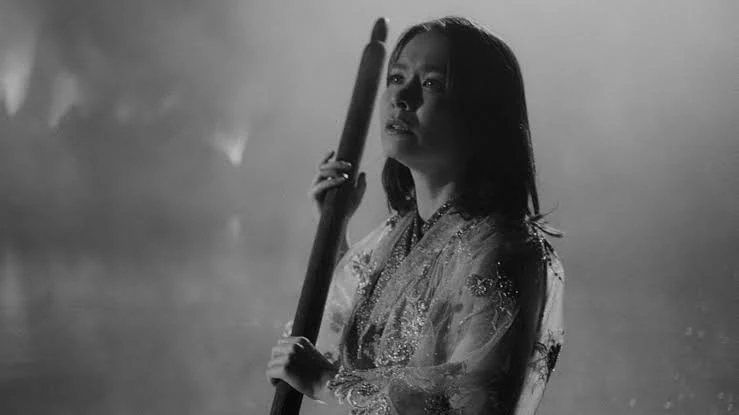
Please Remove Your Shoes. This Song Is a Room. Some songs enter a room politely. They play, they finish, you nod, perhaps add them to a playlist called Late Night Something and then forget they exist until an algorithm returns them to you six months later.
Other songs interfere with the architecture.
Mitski’s “Heaven” belongs to the second category. It does not merely occupy the air around you; it quietly redecorates it. The kitchen becomes dimmer. Your coffee acquires emotional significance it neither requested nor deserves. Somewhere behind the refrigerator, an imaginary upright bass begins playing quarter notes. By the time the strings arrive, you are no longer standing in your apartment at all. You are sitting in a cocktail lounge designed jointly by Edward Hopper, Bill Evans, and somebody’s emotionally unavailable ex.
There is velvet on the walls. The lighting is flattering but morally ambiguous. Every table has a small candle and at least one person pretending not to wait for a text.
That is the peculiar power of “Heaven.” You do not exactly listen to it. You enter it, look around, and gradually realise the door has disappeared.
Then, because the human mind is an embarrassing machine, you begin remembering things. A face. A room. A sentence somebody said seven years ago with no idea that you would preserve it like forensic evidence. Perhaps even that minor-seventh voicing you practised for three weeks and still managed to play badly whenever another musician entered the room.
This is where I should clarify that what follows is not a conventional pop-song analysis. I am not interested in reducing “Heaven” to a neat sequence of techniques, placing each one in a labelled container, and announcing that the mystery has been solved. Songs are not IKEA furniture. You cannot scatter their components across the floor, identify six dominant chords and an orchestral swell, and expect the emotional bookshelf to assemble itself.
What I want to do instead is walk through the hidden jazz club inside this song: a strange, half-lit place where harmony keeps glancing at the exit but never leaves, the orchestra behaves like a very discreet therapist, and the house cocktail is called The Unresolved Suspension.
It is expensive, naturally. It tastes mostly of vermouth and poor decisions.
The Chords Know Where Home Is. They Simply Refuse to Go There. The first thing that makes “Heaven” feel so intoxicating is its relationship with harmonic arrival. The song understands perfectly well where “home” is. It just has no particular enthusiasm for getting there.
This is an old musical pleasure and an even older human one. We claim to want certainty, but certainty is often terribly dull. The moment the answer becomes clear, the spell weakens. Desire survives on distance. Comedy survives on timing. Harmony survives on the possibility that the next chord might finally give us what the previous one withheld.
“Heaven” lives inside that possibility.
Its harmonic language is richer and more evasive than the ordinary pop progression that plants four chords in the ground and spends three minutes walking around them. Major sevenths soften the edges of stability. Ninths leave windows open. Altered dominants appear with the faintly suspicious elegance of a man who arrives at dinner wearing a white suit and refuses to explain where he has been.
Depending on the transcription you are working from, the precise chord symbols may vary, because musicians are incapable of agreeing on notation when disagreement can be made both technical and personal. Still, the underlying behaviour is unmistakable: tonal centres are approached sideways, dominant motion is coloured rather than merely obeyed, and chords that might ordinarily function as destinations are treated as temporary furniture.
You arrive at what appears to be the tonic and think, Good. We are home.
Mitski has already moved the sofa.
That refusal to settle is essential. In less capable hands, harmonic ambiguity can feel like a songwriter has wandered into the wrong key and is hoping confidence will disguise the accident. Here, the uncertainty feels intentional and emotionally exact. The song knows the difference between confusion and suspension. Confusion has misplaced the map. Suspension knows precisely where the road leads and chooses to stop just before the final turn.
This is one of jazz harmony’s great seductions. Jazz does not always ask, “Where are we going?” More often, it asks, “How beautifully can we delay getting there?”
The distinction matters.
A basic triad gives you the name of the room. A major seventh tells you what happened there. Add a ninth and suddenly the room has weather, memory, an unfinished conversation, perhaps a cigarette burning itself out in an ashtray although nobody in the building technically smokes.
Mitski’s melody frequently settles on those expressive upper notes—the tones that do not define the chord so much as complicate its emotional posture. A ninth does not stand at attention. A sixth does not sign a legal declaration. A major seventh leans towards the tonic with unbearable intimacy and then remains one semitone away, which is music theory’s way of saying, “I am close enough to ruin your week.”
That tiny distance is the soul of the song.
Every cadence seems to promise an answer and then deliver a more attractive question. Every phrase reaches towards completion but keeps one finger hooked around the previous moment. You could call this harmonic sophistication. You could also call it commitment issues with excellent voice leading.
Both descriptions are accurate.
The Orchestra Does Not Accompany Her. It Remembers With Her. Then there are the strings.
Pop music has done terrible things to string sections over the years. Strings are frequently summoned to announce that a feeling has become Important. The singer expresses mild disappointment; twelve violins immediately behave as though Vienna has fallen. A chorus arrives, and the cellos begin dragging furniture across the emotional floor.
“Heaven” avoids that trap. Its strings do not pour syrup over the song. They seem to emerge from inside it.
As a violinist, I am naturally biased here, but I am also correct.
The arrangement understands that strings are most affecting when they are allowed to behave like thought rather than decoration. They enter as afterimages, hesitations, private commentary. Sometimes they support the vocal line; sometimes they drift around it, touching a note here, answering a gesture there. At their best, they sound like the feeling that arrives three seconds after a memory—the part your conscious mind did not invite.
Listen to the way the ensemble swells into moments of harmonic tension. The movement is rarely blunt. It does not point at the emotion with both hands and shout, “Sadness! Look, everyone, sadness!” Instead, it gathers beneath the voice and alters the pressure of the room. The violins may lift the upper air; the lower strings add gravity without becoming theatrical about it. Inner voices move quietly, and those inner voices are often where the real ache lives.
This is something arrangers such as Gil Evans understood at a nearly architectural level. Orchestration is not simply a question of which instrument plays which note. It is the art of deciding where attention should fall, how long a colour should remain in the ear, and whether a silence would say more than another bar of sound.
“Heaven” has that kind of restraint. The arrangement listens to Mitski.
That sentence sounds absurd until you hear an arrangement that does not listen. Many arrangements compete with the singer, interrupt her, underline every word, and generally behave like a man at dinner who has mistaken volume for charisma. Here, the ensemble knows when to speak and, more importantly, when to remain seated.
The result has something in common with the great orchestral jazz records, where strings are not used to make the music “classy”—a ghastly word that should be fined whenever it approaches art—but to create psychological depth. Think of the atmosphere surrounding Clifford Brown with Strings, where orchestral colour allows the solo line to appear even more vulnerable. Think of Ravel’s ability to make harmony shimmer without losing structural control. Think of a rainy Tuesday that has read enough literature to become insufferable.
The strings in “Heaven” are not there to tell you what to feel. They behave more like memories: they arrive unannounced, stand too close, and somehow know your name.
Time, Like Everyone Else in This Song, Is Emotionally Compromised “Heaven” also understands something many contemporary productions seem determined to forget: a pulse can be steady without behaving like a prison guard.
The song takes its time. It does not lumber, and it does not become shapeless, but it refuses the nervous urgency of music that has been edited within an inch of its life. There is room around the phrases. Mitski can lean into a word, release one early, allow another to hover over the bar line. The rhythm breathes with her rather than dragging her from one grid point to the next.
That flexibility matters because longing has its own tempo.
Excitement rushes. Panic stumbles. Grief repeats itself. Longing does something stranger: it stretches moments that would otherwise pass quickly. A person can spend three seconds looking at a closed door and experience an entire symphony of speculation. Will it open? Should I leave? Was that a sound? Am I being dramatic? Almost certainly, yes—but that has never stopped anyone.
Mitski’s phrasing often carries this suspended relationship with the beat. She is not careless with time; she is intimate with it. There are moments when she seems to sit just behind the pulse, letting the accompaniment arrive before the word does. Elsewhere she presses slightly forward, as if the thought has escaped before she can contain it. The effect is subtle, but subtlety is exactly the point. Rubato does not need to stagger into the room wearing a cape. Sometimes it is nothing more than the difference between saying something and admitting it.
There is a faint bossa-shaped shadow in the song’s sense of motion—not necessarily as a literal genre label, but as an attitude towards time. The rhythm possesses that soft, circular quality in which momentum never becomes aggression. It sways rather than marches. The music moves, but it does not appear to be in a hurry to prove that movement is happening.
This is one reason the track feels closer to jazz than its surface might suggest. Jazz is obsessed with time, though not always with strict obedience to it. A great player can place a note behind the beat and make an entire room lean backwards. Another can push forward without accelerating, which sounds physically impossible until you hear it done properly.
In “Heaven,” the beat is less a law than a piece of advice.
A persuasive piece of advice, certainly. But Mitski retains the right to appeal.
The Form Keeps Returning, but It Never Returns Innocently On paper, the song’s structure is not especially bizarre. There are recognisable sections, recurring materials, departures and returns. Nobody is required to unfold a seventeen-page diagram or phone a progressive-rock drummer for emergency assistance.
Yet the form never feels mechanical, because each return carries the memory of what has happened since the last one.
That is one of the more profound ideas hidden inside musical repetition. A repeated section is never truly the same section. The notes may be familiar, but the listener is different. Context has altered the temperature. A line that seemed gentle the first time may sound devastating after a bridge reveals what was being withheld. A chord that once felt like rest may later feel like resignation.
Jazz standards depend on this principle. A player may travel through the same thirty-two-bar form several times, but nobody with a functioning imagination expects identical meaning on each pass. The form becomes a landscape. You recognise the road, yet the weather has changed. Someone has turned on a light in a distant house. You have learned something unpleasant about the person travelling beside you.
“Heaven” works in a similar way. Its sections feel familiar without becoming static. The transitions alter not merely the harmony but the emotional air pressure. When the song departs, it does not seem to change key for the sake of novelty. It changes perspective. The light becomes colder or warmer. The walls move slightly closer. By the time familiar material returns, “home” no longer means what it meant before.
This is why form should not be confused with a container. Form is memory organised through time.
A weak form says, “Here is the verse again.”
A strong form says, “Here is the place you were before. Now try standing in it with what you know.”
“Heaven” understands the second kind.
A Brief Visit to the Theory Corner, Where Everyone Is Normal and Nobody Argues About Chord Symbols For those of us who enjoy giving names to sensations—a habit equally common among music theorists and people in therapy—the song offers plenty to examine.
There is modal colouring: notes and chords borrowed from neighbouring tonal worlds, familiar enough to feel connected, foreign enough to disturb the furniture. Modal mixture is one of the most efficient ways to change emotional lighting without demolishing the house. A single borrowed chord can turn afternoon into evening.
There are dominant-function harmonies that seem prepared to behave conventionally and then acquire altered tones, unexpected destinations or enough decorative tension to require their own passport. Secondary dominants create brief gravitational fields around chords that would otherwise pass unnoticed. They announce, for a moment, that some temporary place matters urgently.
Then there are suspensions, those small masterpieces of delayed responsibility. One note remains from the previous harmony while the chord beneath it changes, producing a tension that eventually resolves—or sometimes lingers long enough to establish residency.
Suspensions are proof that music can make procrastination beautiful.
They also explain much of the emotional logic of “Heaven.” A suspension is technically a disagreement between the past and the present. The harmony has moved on. One note has not. It remains where it was, rubbing against the new reality until it can finally descend or rise into acceptance.
That is heartbreak with staff paper.
The melody and harmony are constantly engaged in this kind of negotiation. Mitski’s vocal line does not simply sit on top of the chords like a decorative bird. It presses against them, completes them, questions them. A melodic note may sound fragile in isolation and then become devastating when the harmony beneath it shifts. Elsewhere, the melody offers a consonance that feels less like peace than exhaustion.
This relationship is one of the marks of mature songwriting. The chord progression is not a background over which the “real” material occurs. Nor is the melody an excuse for harmonic cleverness. Each one changes the meaning of the other.
They behave like two intelligent people having a disagreement in a quiet restaurant.
Nobody raises their voice. Everybody at the next table is listening.
And because no theory discussion is complete without one joke that should have been left inside the practice room:
Why did the tonic stop seeing the dominant?
The attraction was powerful, but the relationship only worked when one of them needed resolution.
I apologise. Harmony has consequences.
None of This Would Matter if the Song Did Not Hurt At this point, it would be easy to admire the chords, compliment the orchestration, discuss phrasing, and leave feeling intellectually well fed. That would also miss the reason anyone returns to the song.
“Heaven” hurts.
Not theatrically. It does not throw a wine glass into the fireplace and demand that the entire neighbourhood witness its suffering. Its pain is quieter and more dangerous than that. The longing is built into the way the music behaves. It is not pasted onto the song through lyrics alone. The harmony reaches and delays. The melody leans into tones that remain emotionally exposed. The strings appear like thoughts that were supposed to stay buried. Time itself becomes hesitant.
The sadness is structural.
This distinction matters because harmony without emotional necessity is merely expensive arithmetic. A composer can stack extensions, borrow chords from six modes and modulate through regions known only to migratory birds; none of it guarantees that a listener will feel anything. Complexity is not depth. Sometimes complexity is a man playing fourteen notes because he was frightened of choosing three.
“Heaven” chooses carefully.
Its harmonic language serves a very particular feeling: the desire to inhabit a moment before it disappears. That is why resolution would almost feel dishonest. Full closure would destroy the emotional truth of the song, because longing is rarely tidy enough to end on the correct chord with all voices accounted for.
The song seems to ask a question many people know without wanting to admit it: What if “home” is not a place you can return to? What if it was a person, a brief arrangement of circumstances, a version of yourself that existed only while somebody else was looking at you?
Or worse: what if home still exists, but no longer recognises you?
That is the wound beneath the elegance. “Heaven” does not simply describe intimacy. It creates the sensation of touching something while already mourning its loss.
Anyone who has waited for “I love you” and received “I don’t know” will understand this harmony immediately, regardless of whether they can identify a major seventh. Anyone who has played a beautiful chord and felt that its beauty came precisely from the note preventing it from resting understands it too.
The song makes space for that almost.
Almost loved. Almost safe. Almost home. Almost resolved.
There are few words more musically productive or personally disastrous.
Mitski does not rescue us from the ambiguity. She lets it remain in the room. She pours it a drink. She asks whether it would like the good chair. By the end of the song, your heartbreak has removed its coat and is explaining that it may stay for several weeks.
At least it has excellent taste in harmony.
How to Live Like a Suspended Chord So what, finally, are we supposed to do with a song that refuses to give us the clean arrival we have been trained to expect?
Perhaps nothing.
Perhaps the desire to extract a lesson from every beautiful thing is simply another form of impatience. We hear ambiguity and immediately try to convert it into wisdom, as if uncertainty were an unpaid invoice. Yet some experiences become meaningful precisely because they resist being made useful.
Still, “Heaven” does suggest a way of understanding longing. It presents longing less as an emotional defect than as a form of perception. To long for something is to feel the distance between what exists and what could exist. That distance can be unbearable, but it is also where imagination lives. Art tends to grow there. So do terrible text messages sent after midnight.
Ambiguity, too, has its dignity. Certainty can comfort us, but it can also flatten experience. The unresolved chord remains alive because several futures are still vibrating inside it. Once it settles, possibility collapses into fact.
This may be why we replay certain songs. We already know how they end, yet some part of us continues to hope that the next listening will open a door the previous one left closed. The cadence will turn differently. The lost person will call. The final chord will explain everything.
It never does.
We press play again.
“Heaven” is not a jazz standard in any conventional sense. Nobody is likely to call it at a jam session after “All the Things You Are,” count it off at an alarming tempo and then glare at the pianist during the bridge.
But the song carries jazz’s private logic. It values colour over blunt certainty, phrasing over mechanical precision, return over repetition, tension over immediate relief. It treats harmony as psychology and time as something elastic enough to hold memory.
It feels like jazz’s secret diary: intimate, harmonically restless, slightly embarrassed by its own sincerity.
And perhaps that is the finest thing about it. The song does not break rules in order to display intelligence. It seems to have absorbed the rules so completely that it can forget them at exactly the right moment. Its sophistication never stands between the listener and the feeling. The theory is there, certainly, but it works underground, moving pipes, changing the water pressure, making sure the room floods at the correct emotional temperature.
You are inside the song.
The door is still missing.
Postlude for People Who Have Never Resolved Anything Properly If you have reached the end of this essay, congratulations. You are now legally permitted to make tritone jokes at parties, explain upper extensions to strangers who were clearly trying to leave, and say “the voicing is doing most of the emotional work” whenever ordinary conversation becomes insufficiently dangerous.
Use this authority responsibly.
As for me, I will continue listening to “Heaven,” studying its harmonies, admiring its restraint, and maintaining a completely reasonable, academically defensible affection for the woman who wrote it.
Somewhere, it is midnight. Somebody is walking home beneath a row of streetlights, hoping the next window contains a life they might have lived. Somebody else is sitting at a piano, playing a chord that refuses to settle because settling would mean admitting the moment is over.
And perhaps that is all longing really is: a note from the old harmony still sounding after the world beneath it has changed.
Some songs fill a room.
Some songs change the weather.
“Heaven” changes the floor plan, hides the keys, and leaves a major seventh burning softly in the hallway.