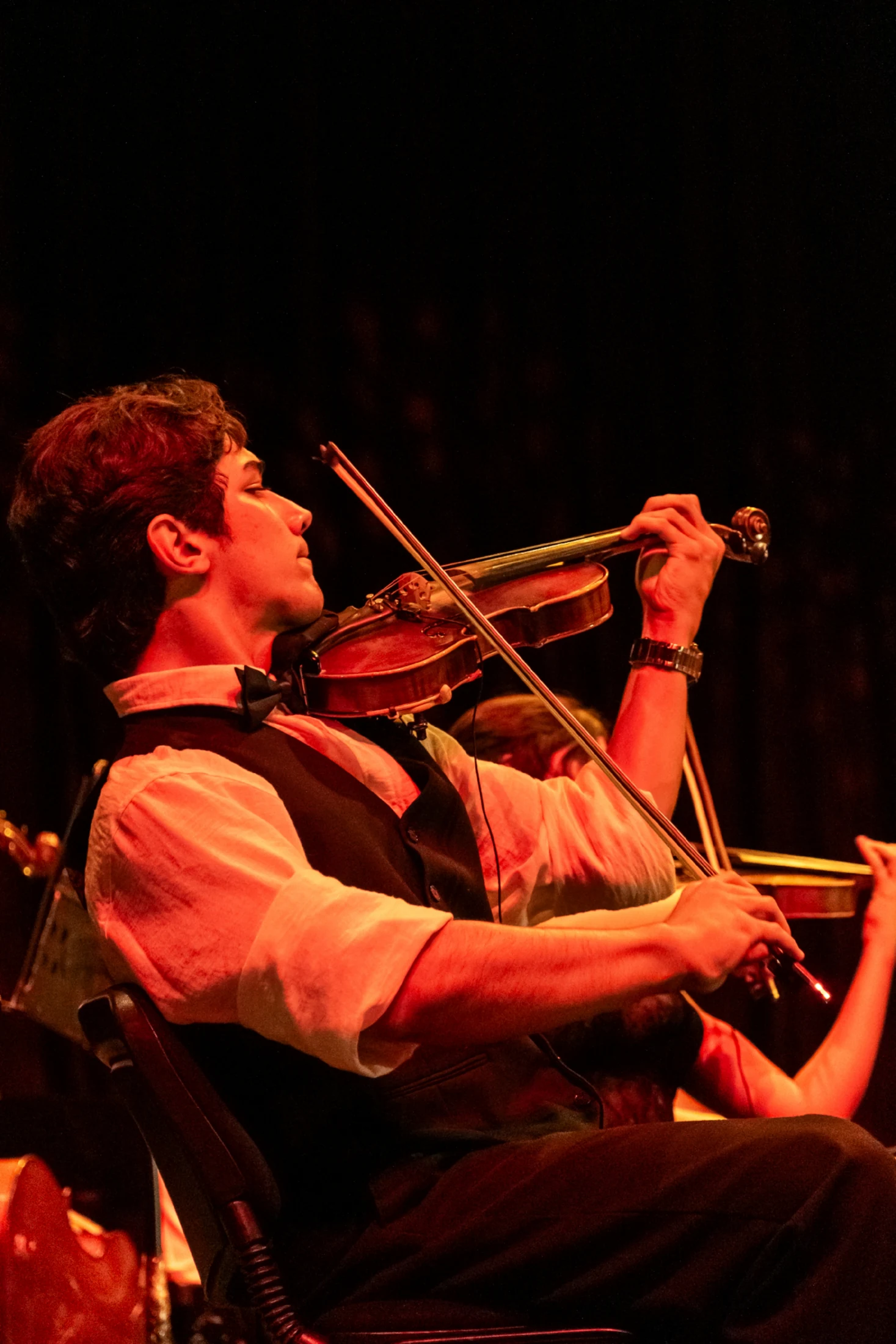
An online violin lesson should not begin with a student balancing a phone against a coffee mug while the teacher spends ten minutes asking whether the bow is still somewhere outside the frame.
The format works well when it is treated as an intentional teaching environment rather than a video call with an instrument in the room.
At ARSLAN CLASSICS — Academy of Music & Arts, lessons are conducted primarily through Zoom. The student receives the link shortly before the session, and the same meeting link is generally retained for future lessons. Google Meet serves as the first technical alternative; WhatsApp video is available as a final fallback. The objective, however, is not to travel through three applications every week. It is to establish one stable system and allow the lesson to remain about violin.
Once a student has joined a programme, I provide a short online-lesson setup guide covering Zoom installation, Original Sound for Musicians, lighting, camera height, score placement, audio checks, tuning and the amount of the instrument that should be visible on screen. During the first lesson, we may spend the opening five to ten minutes refining that setup together.
This is not decorative preparation. A poor camera angle can conceal the very mechanism we are trying to understand.
A computer is preferable, although a tablet is entirely workable. A phone may be used when necessary, but relying on it as the main device can reduce visual clarity and make score reading unnecessarily cramped. Music may be placed on a physical stand or displayed on a sufficiently large second screen. A score written for the violin deserves slightly more territory than a phone notification.
The student should stand or sit far enough from the device for me to see the instrument, upper body, both arms, general bow path and left-hand movement. The room must allow a little movement. During one part of the lesson I may need to observe the entire posture; five minutes later, the left thumb or the fourth finger of the bow hand may become the centre of the discussion.
The student does not need an elaborate multi-camera studio. One properly positioned camera is enough. When necessary, I ask them to move closer, step back or turn the device slightly. These adjustments usually take seconds. On my side, I may use one or two cameras depending on whether the lesson requires a broad demonstration or a close view of a specific hand movement.
An external microphone is welcome but not compulsory. A functioning camera, clear microphone and stable internet connection are the practical essentials. The student’s equipment and connection inevitably affect what can be heard and seen; prolonged technical interruptions also reduce the usable lesson time. For that reason, checking the setup beforehand is part of preparing for the lesson, much like tuning the violin before beginning to play.
A metronome and tuner appear in almost every session. I prefer the student to run a combined tuner-and-metronome application on a separate phone while Zoom remains open on the computer or tablet. When both functions compete on the same device, the tuner may begin listening to the teacher’s voice, the speaker output or anything except the note it was invited to examine. A separate phone keeps the arrangement considerably more civilised.
From the first note to the final assignment
After a brief greeting, I normally begin by listening to the previous week’s work. While the student plays, I try not to interrupt unnecessarily. I want to hear the genuine version of the assignment: how the passage holds together, where the rhythm changes, what happens under pressure and which problems appear without prompting.
Only then do we analyse.
A visible mistake may originate somewhere unexpected. An intonation problem can begin in the balance of the hand; a bowing issue may be connected to the fourth finger; an unstable passage may be rhythmic before it is technical. We isolate the difficulty, alter one condition at a time and determine what the student is actually feeling. The camera may move closer. The tempo may be reduced. A passage may be tested on open strings, separated into smaller units or repeated with a metronome.
Depending on the programme and the student’s stage, lessons may draw from the Maia Bang Violin Method, scales, exercises, études and repertoire. I do not use one book as an automatic route imposed on every person. A structured method provides continuity; the student’s real needs determine where we pause, what we combine and when we move forward. When English instructions in the material require clarification, I explain and translate them in Turkish so that language does not become an accidental technical obstacle.
Scores and essential PDFs are normally sent before the lesson through WhatsApp, with enough time for the student to prepare them. Screen sharing is reserved for material that genuinely benefits from being viewed together: an annotated passage, a document, a particular recording, a YouTube performance or a reference that the student does not need to keep permanently. Fingering, bow directions, rhythmic divisions and practice sections can then be marked and discussed directly.
Internet latency makes perfectly simultaneous playing unreliable. Fortunately, individual violin teaching does not depend on pretending that two delayed audio streams form an ensemble. I demonstrate; the student listens; then the student plays while I observe. Rhythm can be supported by the metronome on the student’s side, where no network delay interferes with the pulse.
Lessons are not recorded automatically. I strongly recommend keeping a notebook—physical or digital—nearby. A detail mentioned during a lesson may become the key to the entire week’s practice, and memory has an unfortunate habit of editing technical instructions shortly after the call ends. At important moments, I may ask the student to write something down or retain a short, clearly identified explanation, but recording the full lesson is not the default.
Toward the end of the session, we review what changed and establish the next week’s priorities. After the lesson, I send a written or voice-message summary through WhatsApp: what to practise, how to practise it, which tempo to use, which error to watch for and what should be ready for our next meeting.
The live session is the centre of the programme, but it is not the edge of it. Video feedback, individual demonstration videos and messaging support continue between lessons according to the selected package.
Online teaching has honest limitations. I cannot physically reposition a student’s hand, and inadequate sound, lighting or camera resolution may restrict what can be observed. Yet the format also gives us a documented and carefully organised process: scores arrive in advance, demonstrations can be shown from more than one angle, focused videos can be reviewed, and weekly practice does not have to depend on what the student happens to remember.
A successful online lesson is therefore not a lesser face-to-face lesson.
It is a different room—built deliberately around observation, explanation and work that continues after the screen goes dark.